
Batangtoru Ecosystem
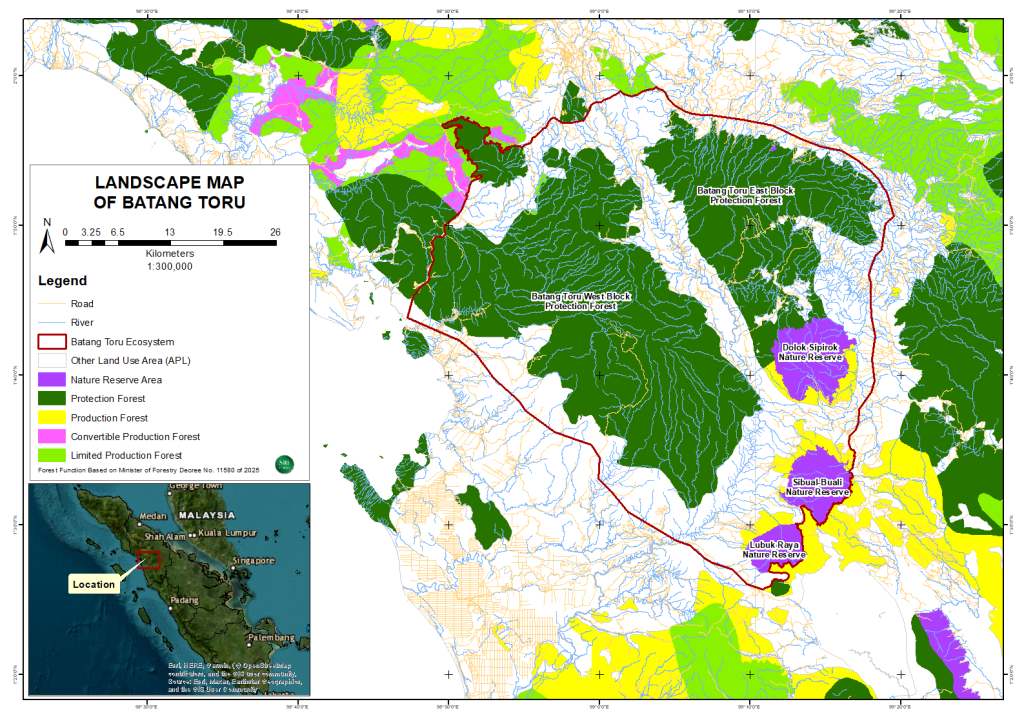
The Batang Toru Ecosystem, often called Harangan Tapanuli, is one of the most important tropical rainforest landscapes on the island of Sumatra. Spanning across three regencies—South Tapanuli, Central Tapanuli, and North Tapanuli—the area encompasses a combination of lowland forests to high-altitude mountains that serve as a regional green lung and a global biosphere balancer.
Socially and economically, communities around the Batang Toru region depend heavily on natural resources, working as farmers, gatherers of non-timber forest products, or engaging directly with strategic industrial activities such as large-scale plantations, gold mining, and renewable energy projects like geothermal and hydropower.
The biodiversity in the Batang Toru Ecosystem is exceptionally high, recognized as a global biodiversity hotspot with an extraordinary concentration of flora and fauna species in Southeast Asia.
The primary highlight of Batang Toru’s biodiversity is the presence of the Tapanuli Orangutan (Pongo tapanuliensis), the most endangered great ape species in the world with a population of fewer than 800 individuals, living exclusively in this ecosystem.
Aside from orangutans, the Batang Toru landscape is also home to two other key Sumatran wildlife species living together in a rare coexistence: the Sumatran Tiger and the Sumatran Tapir, indicating that the forest’s food chain remains functional.
Despite its high ecological value, conservation challenges in Batang Toru are at an alert level due to habitat fragmentation from land conversion, infrastructure development, poaching, and human expansion along the forest boundaries.
This environmental vulnerability is further exacerbated by natural dynamics such as the risk of ecological disasters, including flash floods and post-disaster landscape changes that threaten the physical safety of the habitat and local residents.
To address these threats, conservation strategies in Batang Toru require an integrated approach involving data-driven spatial planning, strengthening the conservation status of the area, and active community engagement to harmonize economic development with the preservation of this natural heritage.
Amidst these complex challenges, the Sumatra Rainforest Institute (SRI) plays a strategic role by focusing conservation initiatives on the restoration and protection of wildlife corridors at several key spots through an integrated approach combining sustainable livelihood agroforestry coffee, community-based forest and wildlife protection patrols, conservation awareness campaigns, planting and maintenance of riverbank and tributary trees, and the development of farmer cooperatives.