

Siondop Angkola Ecosystem
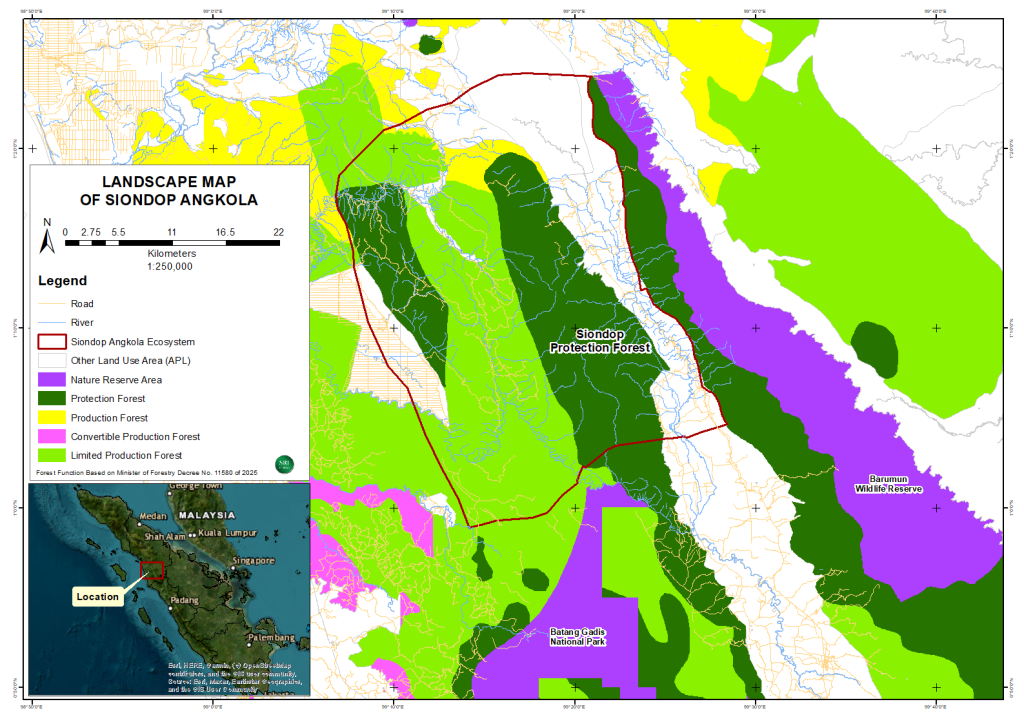
The Siondop-Angkola Landscape is a highly strategic tropical forest ecosystem that plays a crucial role as an ecological buffer in the North Sumatra region, covering an area of approximately 195,000 hectares. This region not only functions as a hydrological regulator and erosion prevention mechanism for surrounding areas, but also serves as an essential part of the ecological landscape linking major conservation areas across the island of Sumatra. The existence of this landscape is vital for maintaining regional environmental balance, which is increasingly pressured by global climate change.
From a biodiversity standpoint, this area harbors high-value tropical rainforest flora and fauna, including serving as a home for various endangered species such as the Sumatran Orangutan. Diverse vegetation types, ranging from lowland forests to mountainous zones, thrive here, providing natural habitats and critical migration pathways for various protected wildlife species. This makes it one of the final bastions of biodiversity in the South Tapanuli and North Tapanuli regions.
The most essential function of the Siondop-Angkola Landscape is its role as an ecological corridor connecting fragmented forest areas. Through this green corridor, the movement and home ranges of wildlife can be maintained without forcing them to become isolated within narrow habitat pockets. The presence of such a corridor is vital to prevent local extinction caused by inbreeding among animals and to ensure the long-term survival of key wildlife populations.
Socially and culturally, the areas surrounding this landscape are inhabited by local and indigenous communities that share deep historical, cultural, and spiritual connections with nature. The daily lives of communities living near forest areas rely heavily on natural resource availability, with many still practicing traditional management systems and customary laws that regulate environmental use in a limited manner. This close relationship between the community and the forest shapes the unique social landscape of Angkola and its surroundings.
From an economic perspective, most residents around this landscape depend on the agrarian sector for their livelihood. Primary economic activities include dryland farming, community-managed plots such as rubber and horticultural commodities, and the utilization of Non-Timber Forest Products (NTFPs) such as rattan and honey. This high economic reliance on land-based sectors means that community welfare dynamics are heavily influenced by natural productivity and surrounding environmental conditions.
However, beneath its ecological and socio-economic potential, this landscape faces severe threats from deforestation and forest fragmentation. Pressures from sporadic land conversion for new plantation expansion, illegal encroachment, and urban settlement growth have broken primary forest blocks into isolated fragments. This massive loss of forest cover not only damages landscape integrity but also triggers environmental degradation that directly impacts human and wildlife communities.
The secondary consequence of such forest fragmentation is a decline in overall ecosystem quality and an increase in spatial planning conflicts. Overlaps between protected area functions and plantation concession permits, land-use licenses, and community farms complicate environmental protection and law enforcement efforts. Furthermore, disruptions to environmental service functions frequently trigger vulnerability to ecological disasters, such as landslides and flash floods in downstream areas.
Facing these various complexities, the primary conservation challenge in the Siondop-Angkola Landscape is how to harmonize community economic needs with environmental protection efforts. Strong commitment is required through cross-sectoral collaboration involving the central government, local governments, indigenous communities, academics, and environmental organizations to preserve the remaining green corridors. Only through participatory spatial management, the restoration of degraded areas, and the development of alternative economies can the sustainability of this 195,000-hectare ecosystem be achieved for the long term.